

Manufacturing & Advanced Industrials · Technology, AI & Digital Transformation
AI Predictive Maintenance
Spot failing equipment early and plan repairs before breakdowns stop production
Discuss this serviceWhat it is
AI Predictive Maintenance
We design and implement Predictive Maintenance (PdM) and Reliability-Centred Maintenance (RCM) programmes. By combining vibration and temperature sensors with machine learning anomaly detection, we help maintenance teams move from reactive repairs to planned, condition-based work.
- Typical duration
- 6 to 12 weeks for a pilot; scalable across the plant
The business problem
Why clients need this
Unplanned breakdowns cost manufacturers significant lost output, while calendar-based maintenance often services healthy machines and consumes spares that were not needed.
- 01
Failures of critical motors, gearboxes, pumps, and compressors stop production with little warning.
- 02
Spares inventory is padded with slow-moving parts to cover the risk of sudden breakdowns.
- 03
Maintenance teams lack tools to tell whether vibration comes from unbalance, misalignment, or bearing wear.
Our approach
How we deliver it
- 1
Asset Criticality Ranking & FMEA
Ranking equipment by likelihood of failure, production impact, safety consequence, and repair lead time.
- 2
Sensor Selection & Connectivity
Installing tri-axial vibration, temperature, and current sensors connected through industrial IoT gateways.
- 3
Model Development
Building anomaly detection models from frequency spectra and operating data, and adding remaining-life estimates where failure history allows.
- 4
CMMS & Workflow Integration
Generating work orders in your CMMS or ERP automatically when alert thresholds are crossed.
Data & AI
How technology strengthens this service
Models run on edge gateways to analyse high-frequency vibration data close to the machine, aiming to detect early-stage bearing and gear faults well before noise or temperature rise makes them obvious.
How we use AI across our workTypical deliverables
What you receive
- Asset Criticality & Failure Modes and Effects Analysis (FMEA) Matrix
- Sensor & Gateway Deployment Architecture for the pilot area
- Machine Health Dashboard (cloud or on-premise) with Automated Alerts
- CMMS Work-Order Integration
Outcomes
What changes for you
- Fewer unplanned stoppages on critical equipment, tracked against a pre-pilot baseline
- Maintenance effort and spares directed by measured condition rather than the calendar
- A tested pilot and business case for scaling across the plant
Who it is for
- Continuous process industries (cement, steel, paper, chemicals)
- Heavy manufacturing & fabrication plants
- Power utilities & pumping stations
- Logistics & automated material handling hubs
FAQs
Common questions
Which machines are best suited to predictive maintenance?+
Critical rotating equipment: motors, gearboxes, centrifugal pumps, large fans, air compressors, extruders, and CNC spindles.
Does this need cloud connectivity, or can it run on-premise?+
Either. We can deploy to a secure cloud or keep everything on-premise within your OT network, including air-gapped environments.
How much historical failure data do we need?+
Very little to start. Anomaly detection models learn a machine's normal behaviour over the first few weeks after installation and flag deviations from it. Failure history, where available, improves remaining-life estimates.
Related
More from Manufacturing & Advanced Industrials

Plant Productivity & OEE Diagnostic
Data-led loss analysis that finds spare capacity in your existing lines before you spend on new ones.
Explore the service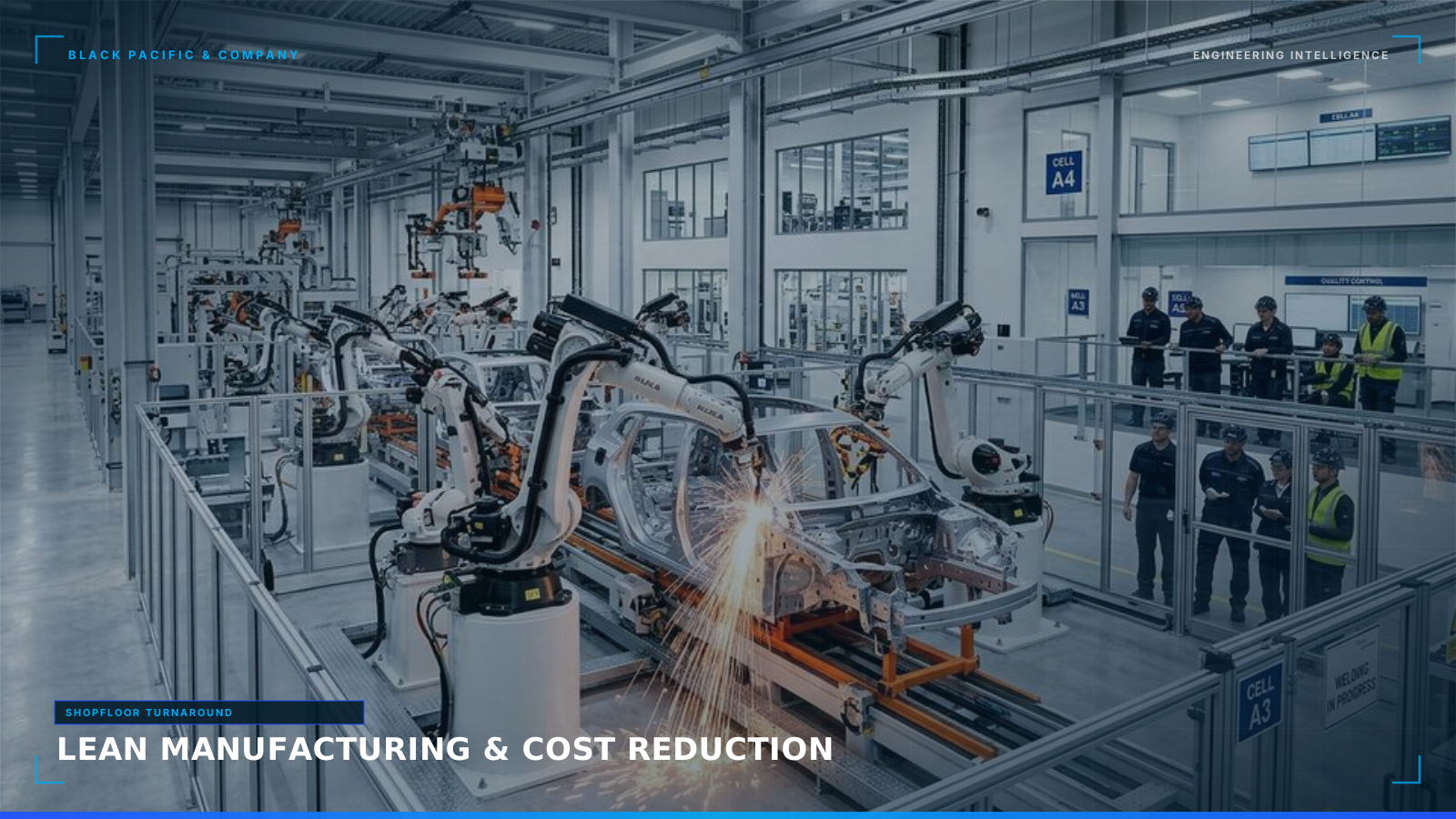
Lean Manufacturing & Cost Reduction
Hands-on shop-floor improvement that removes waste and lowers cost per unit.
Explore the serviceCompressed Air, Steam & Process Systems Audit
Measured audits of compressed air, steam, and process utility systems to find leaks, waste, and efficiency gains.
Explore the service
Reliability Engineering & Root Cause Analysis
Criticality ranking, failure investigation, and maintenance strategy for rotating and process equipment.
Explore the serviceArticle · Manufacturing & Advanced Industrials
From reactive to predictive: a practical maintenance roadmap for manufacturers
Predictive maintenance pays off when it starts small, on the right equipment, with the basics in place.
18 June 2026 · 6 min read
Discuss ai predictive maintenance with our team
Tell us about your site, plant or network. A senior consultant will reply within two business days.