
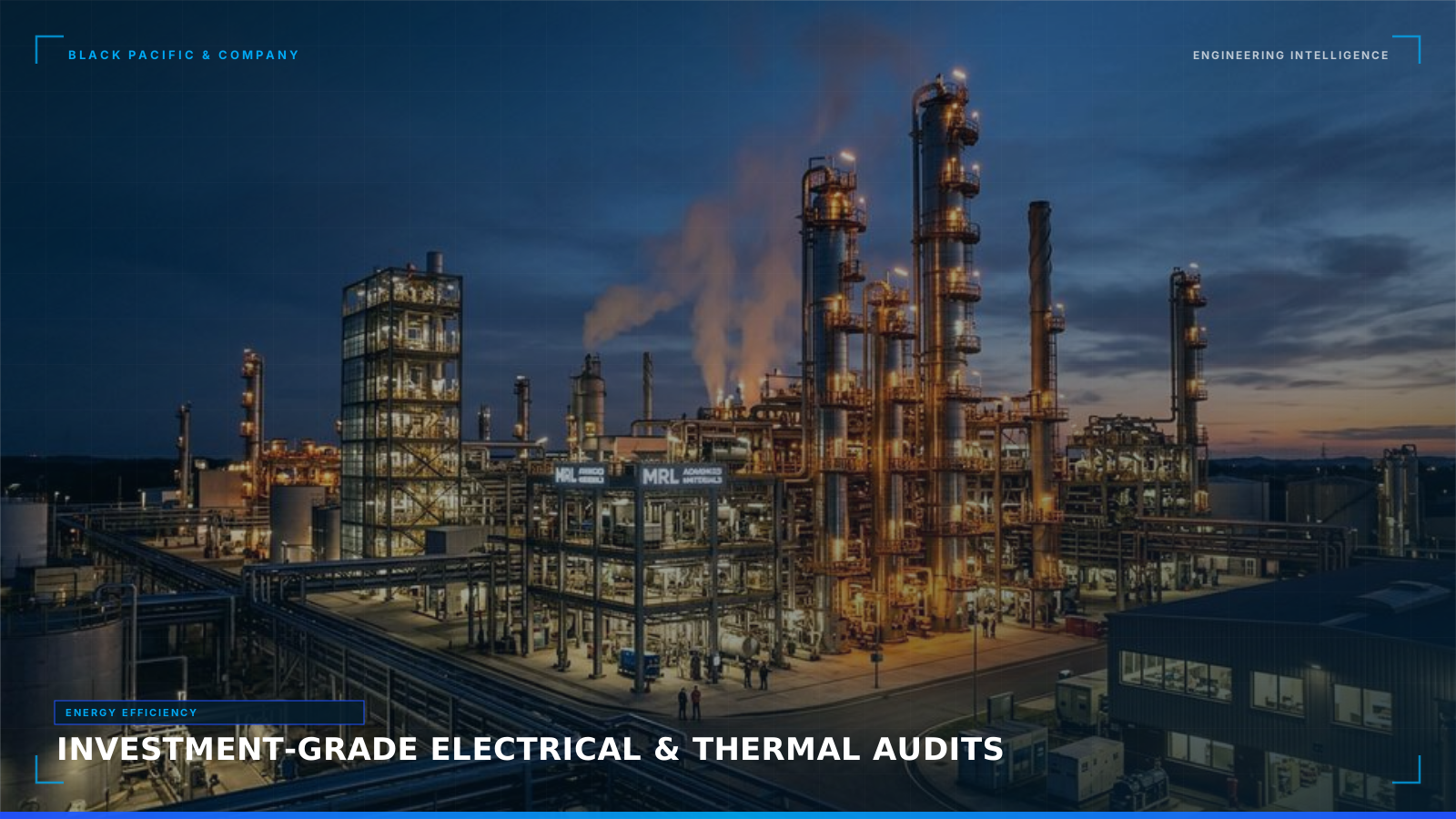
Energy, Utilities & Renewables · Risk, Resilience & Sustainability
Industrial Energy Audit
Find out where your plant loses energy, and which fixes pay back fastest
Discuss this serviceWhat it is
Industrial Energy Audit
An industrial energy audit measures where energy goes across your facility. Our team measures electrical distribution, motors, compressed air, boilers, chillers, and furnaces, then ranks savings measures by cost and payback.
- Typical duration
- 3 to 6 weeks
- Industry
- Energy, Utilities & Renewables
The business problem
Why clients need this
Industrial power and fuel costs keep rising while decarbonisation expectations tighten. Many plants lose a meaningful share of their energy to unoptimised thermal systems and electrical losses that nobody is measuring.
- 01
Harmonics, low power factor, and voltage dips damage sensitive equipment and trigger utility penalties.
- 02
Boilers, steam lines, and compressed air systems run with undetected leaks and poor efficiency.
- 03
Without sub-metering, plants cannot see energy use by line, process, or product.
Our approach
How we deliver it
- 1
Baseline & Tariff Analysis
Reviewing 12 to 36 months of utility bills, contract demand, power factor penalties, and time-of-day tariffs.
- 2
On-Site Measurement
Power quality analysers, thermal cameras, ultrasonic leak detectors, and flue gas analysers on all major energy users.
- 3
System Energy Balances
Building energy balances for steam, compressed air, chilled water, and motor drives.
- 4
Prioritised Savings Measures
An Energy Conservation Measure (ECM) plan with capex, annual savings, and simple payback for each item.
Data & AI
How technology strengthens this service
Regression models relate energy use to production volume and ambient temperature, giving a fair baseline for measuring savings and flagging abnormal consumption once measures are in place.
How we use AI across our workTypical deliverables
What you receive
- Energy Audit Report prepared using ISO 50002 and other agreed guidance, as applicable
- Power Quality & Harmonic Analysis with mitigation recommendations
- Prioritised ECM Matrix with Capex, Savings, and Simple Payback
- Specific Energy Consumption (SEC) Baseline & Tracking Dashboard
Outcomes
What changes for you
- Target 10–20% reduction in facility energy cost, in line with typical industrial audit benchmarks
- Power factor and maximum demand penalties identified and addressed
- A measured emissions baseline and reduction plan that supports ESG reporting
Who it is for
- Process & discrete manufacturing plants
- Chemical, pharmaceutical & textile units
- Commercial campuses & hospitals
- Data centres & cold storage facilities
FAQs
Common questions
Can the audit support a utility or regulatory review?+
Requirements vary by jurisdiction, utility, and facility type. We document the methods, measurements, and applicable standards used so the relevant reviewer can assess the report.
What payback can we expect on recommended measures?+
Operational changes often cost little and pay back within months. Equipment retrofits such as VFDs or waste heat recovery commonly pay back within one to two years, depending on usage and tariff.
Will power quality logging disrupt production?+
No. We use clamp-on current transformers and voltage probes that are installed while the plant is running, with no shutdown needed.
Related
More from Energy, Utilities & Renewables
Renewable Energy Advisory
Feasibility, roof structural checks, EPC procurement, and PPA structuring for commercial and industrial solar.
Explore the service
Decarbonisation Strategy
Scope 1, 2 & 3 emissions accounting, product footprints, and practical decarbonization roadmaps.
Explore the service
Arc Flash Studies
Short-circuit, arc flash, and protective device coordination studies that support electrical safety programs.
Explore the service
Electrical Commissioning
Independent testing and verification of new or modified electrical systems before they go into service.
Explore the service
Utility Rate Optimisation
Analysis of rates, demand charges, and load profiles to lower electricity cost without disrupting operations.
Explore the serviceArticle · Energy, Utilities & Renewables
Industrial power strategy starts with the load profile
A measured view of demand, utility terms, power quality, and operating constraints is the starting point for energy decisions.
11 October 2026 · 4 min read
Discuss industrial energy audit with our team
Tell us about your site, plant or network. A senior consultant will reply within two business days.